Søren Kamper
Some Star Wars games endure because they give the player something more useful than destiny: a job.
Star Wars has spent decades telling us that anyone might be important, then handing the player a lightsaber just to be absolutely certain. That is understandable. Lightsabers are excellent marketing tools, make a pleasing noise, and solve most workplace disagreements with alarming efficiency. But across more than four decades of Star Wars games, some of the most convincing trips to the galaxy far, far away have worked for the opposite reason. They do not make the player the centre of history. They give the player a job inside it.
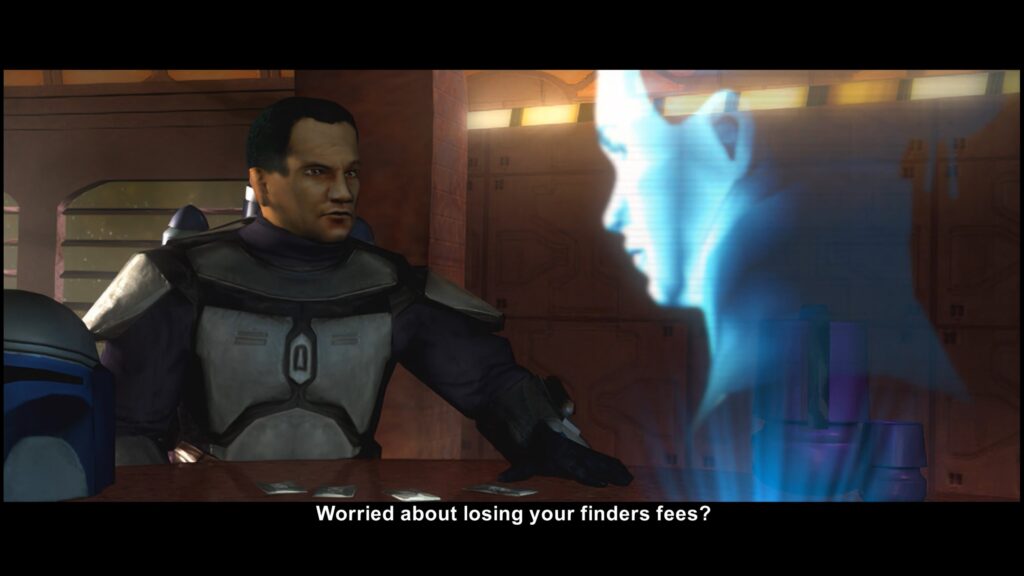
That is why Star Wars: Bounty Hunter remains interesting long after its 2002 machinery has started to creak. The levels can be confusing. The camera occasionally behaves as though it has accepted a separate contract. Combat has the loose, slightly floaty character of an era when third-person action games were still negotiating the terms of employment. Yet the fantasy underneath all of that is remarkably clear: you are Jango Fett, and there is work to do.
The job gives the game a spine
Bounty Hunter does not merely dress Jango in familiar armour and send him through a sequence of Star Wars-shaped corridors. Its strongest ideas come from the profession itself. Jango scans crowds for wanted targets, marks them, decides whether they are more valuable alive or dead, uses a whipcord to restrain them and carries an arsenal that looks less like a hero loadout than the contents of a very well-funded toolbox. Even when the execution is awkward, the mechanics keep returning to the same question: what would a working bounty hunter actually need?
That matters because role is one of the simplest ways a licensed game can turn scenery into a place. Coruscant is impressive in a film because it is impossibly large. It becomes something different when the player is moving through its industrial levels looking for a target. Tatooine stops being a famous postcard and becomes territory. A cantina is not there because the audience expects a cantina. It is there because this is the kind of room where somebody knows somebody who owes somebody money. The job reorganises the galaxy around practical concerns, and suddenly the player is not touring Star Wars. The player lives there, at least until the next load screen.
X-Wing understood this before most games did
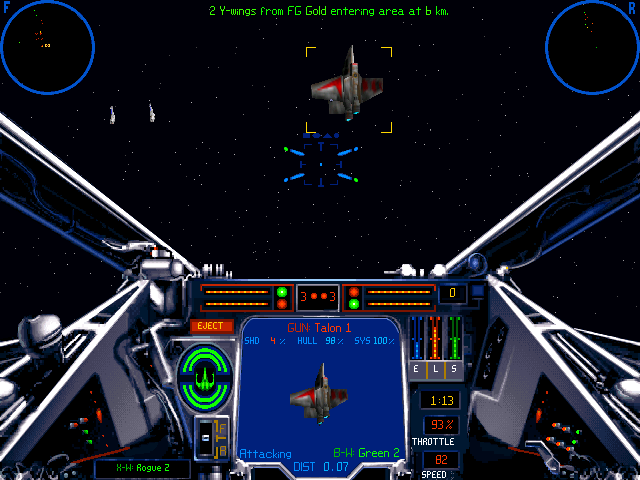
The same trick is one reason the old X-Wing and TIE Fighter era of space-flight games still has such a powerful grip on people who were there. X-Wing did not need to explain that the player was special. It gave the player instruments, shields, laser controls, target identification, wingmen and mission objectives. The cockpit did most of the storytelling. You were a Rebel pilot because the game made you think like one.
That distinction sounds small until you compare it with games that treat Star Wars mainly as a collection of recognisable objects. An X-Wing on a loading screen is iconography. An X-Wing cockpit in which the player is desperately shunting shield power to the rear while a TIE fighter turns the radar display into an accusation is a role. The fantasy survives old graphics because the rules still ask the player to perform the job.
The galaxy gets bigger when the player gets smaller
Republic Commando pushes the idea in another direction. Delta Squad matters, but not because four clone commandos have been informed by an ancient prophecy that they alone can restore balance to the Force. They are soldiers. The verbs are military verbs: breach, secure, revive, cover, advance. The famous squad-command system is not a decorative extra sitting on top of a shooter. It is the thing that makes the shooter feel like Republic Commando rather than a Star Wars texture pack fitted over a conventional FPS.
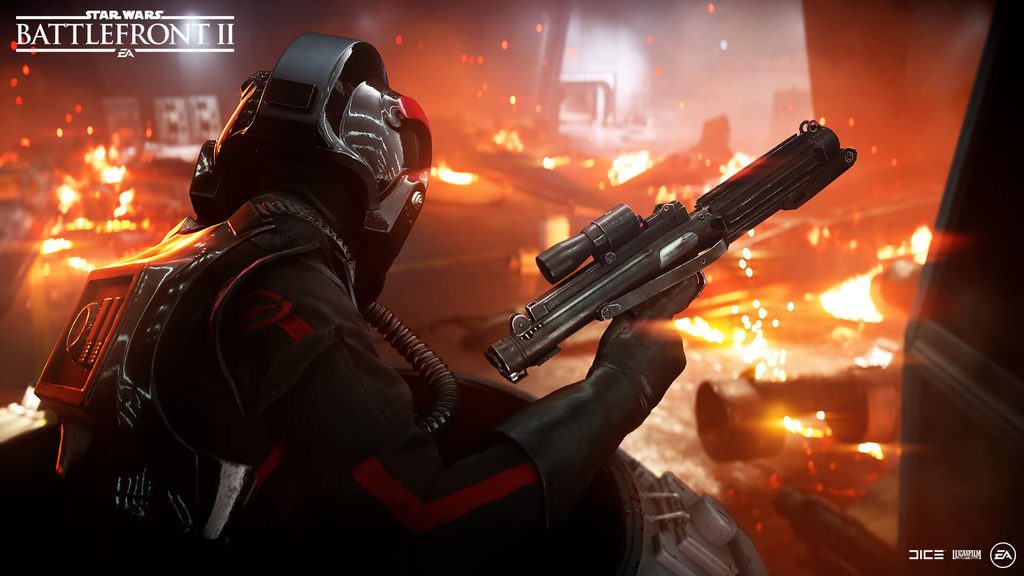
Battlefront works for much the same reason when it puts the player among ordinary troops. A battlefield feels larger when Darth Vader is not the player’s default condition but the terrifying thing that has just entered the room. The modern Star Wars: Zero Company takes this occupational fantasy into turn-based tactics, building its drama around a battered company of soldiers, mercenaries, clones and specialists trying to complete missions inside a war much bigger than themselves. Star Wars becomes more believable when the player has responsibilities smaller than saving existence itself.
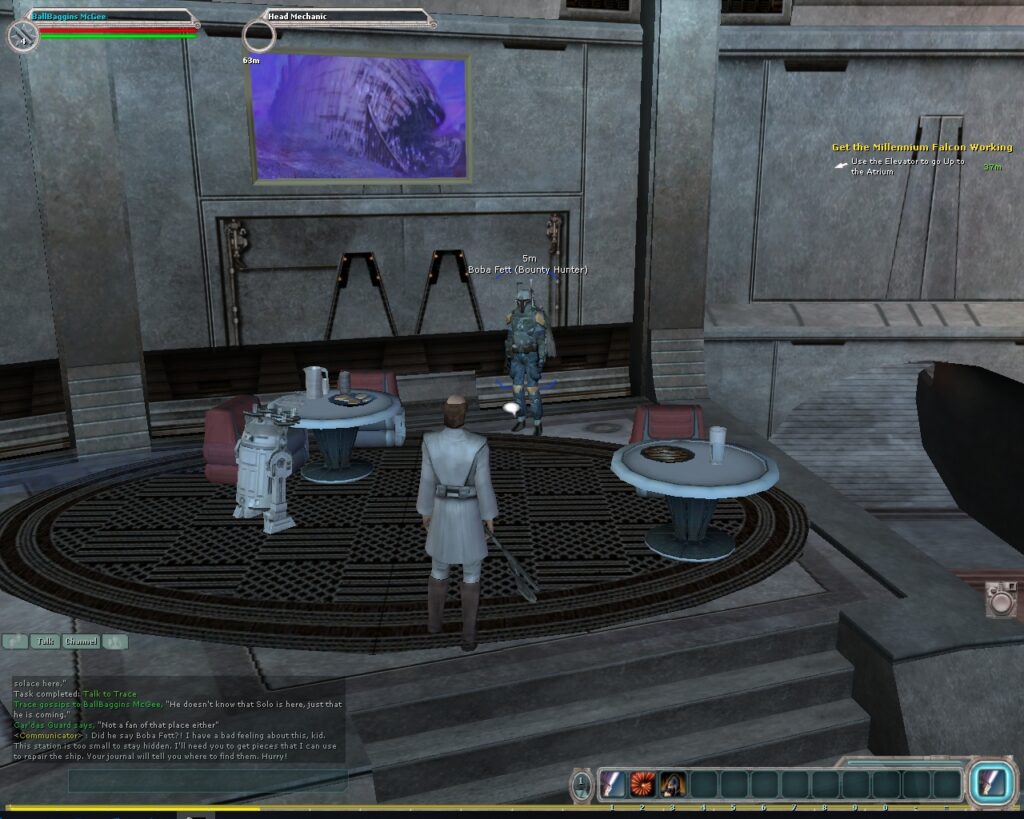
Star Wars Galaxies turned jobs into a world
No game took the argument further than Star Wars Galaxies. Its great trick was not simply that it let thousands of people inhabit Star Wars at once. It allowed many of them to inhabit it without behaving like the protagonists of a film. The galaxy needed crafters, entertainers, traders, doctors, bounty hunters and people who were very serious indeed about where a player city should place its municipal buildings.
That sounds less glamorous than becoming a Jedi, and that was precisely the point. A fictional world begins to feel convincing when it contains people whose Tuesday afternoon does not involve the fate of civilisation. Galaxies understood that the moisture farmer, weaponsmith and cantina entertainer are not background noise around Star Wars. They are part of the mechanism that makes the heroic material feel as though it is happening somewhere rather than on a set waiting for the main characters to arrive.
Outlaws makes criminality a routine
Star Wars Outlaws is a much newer example, but its strongest moments often come from the same old idea. Kay Vess is not interesting because she is secretly the most important person in galactic history. She is interesting because she needs money, contacts, transport and enough goodwill with dangerous organisations to avoid being shot before lunch. Sabacc, reputation systems, contracts, sneaking through restricted territory and taking jobs for people who should not be trusted all support the scoundrel role.
The open world helps, but size alone is not the magic ingredient. A huge map can still feel like an exhibition hall. Outlaws becomes more persuasive when the world asks Kay to behave like someone from its underworld. A syndicate-controlled district means something because reputation changes whether she can walk through the front door. A cantina means something because information can be useful. A speeder means something because a person doing dubious work across a moon eventually needs to get from one dubious appointment to the next.

The rough edges matter less when the fantasy is clear
This is why Bounty Hunter can still work when so many individual pieces plainly belong to 2002. The role gives those pieces a common purpose. The scanner is awkward because bounty hunting is the point. The jetpack is limited, but it is Jango Fett’s jetpack. The levels sometimes resemble architectural revenge, but they are places a contract has sent him. The game knows what the player is meant to be, and that clarity carries a surprising amount of weight.
Star Wars games will always return to Jedi, and they should. Swinging a lightsaber remains one of gaming’s most reliable methods of turning a sensible adult into an eight-year-old within three seconds. But the galaxy is often at its richest when the player is given a narrower brief. Fly the fighter. Lead the squad. Hunt the target. Smuggle the cargo. Keep the company alive. Make enough credits to pay for whatever is going to break next.
The best role-based Star Wars games understand something the films have always implied: the galaxy feels enormous because most of the people in it are not Luke Skywalker. They have shifts, contracts, debts, commanders, customers and problems that will not be mentioned in an opening crawl. Give the player one of those lives, and even a game with stiff controls and twenty-year-old level design can still feel wonderfully specific. Sometimes the job really is stronger than the jank.
To read more about Star Wars games from Søren Ahrensborg Kamper, head over to his independent publication Star Wars: Gaming.
 Chris Inglis